Of the 50% of the South African population that live in 17 of the largest municipalities, 40% live in metropolitan municipalities (Stats SA, 2022), but the city no longer stops at the municipal boundary – city regions are evident. This fact is recognised by the South African Cities Network (SACN) Strategic Business Plan 2026-2031, which will be implemented with effect from 1 July 2026 – it continues to focus on urbanisation but now applies its mandate through a city-region lens, including selected intermediate city municipalities (ICMs) that shape functional urban systems and corridors linked to metros.
A city-region is defined as a functional urban system centred on a major city and extending into surrounding municipalities. A city-region lens enables SACN to engage at the scale where people live, work and access opportunities, recognising that labour markets, housing markets, transport networks, infrastructure systems and natural assets operate across municipal jurisdictions.
ICMs are large municipalities with high populations and are crucial hubs for regional development because they are situated along transport corridors or near resource-rich areas. Furthermore, these ICMs are important places of service delivery and economic growth that require complex governance, but not at the scale of metros. There are 39 ICMs recognised by the ICM Support Programme in the Department of Cooperative Governance, which play a unique role between large metropolitan areas and smaller local municipalities. Many ICMs are linked to metros through commuting patterns, labour flows, logistics corridors, service catchments and investment flows, and these linkages shape city performance, spatial transformation and resilience outcomes.
The research points to a shift in urbanisation patterns from primary/metro cities and global cities to city regions. The evidence can be found in the literature on city regions such as São Paulo’s macrometrópole or the Pearl River Delta, where urban systems function through shared economies, mobility networks, infrastructure systems and natural assets that extend across municipal boundaries.
A growing body of continental and national evidence demonstrates that urbanisation in Africa is no longer defined by the growth of primary and/or isolated cities, but by the expansion of large urban agglomerations and functionally integrated city regions. Research on urbanisation in Africa shows that the population is projected to grow rapidly between 2020 and 2050, with most of the demographic growth occurring in urban areas and with built-up urban footprints expanding well beyond existing municipal boundaries (OECD, 2025). These dynamics are already evident in South Africa, where economic activity, labour markets, transport systems, and settlement patterns routinely cut across metropolitan, local, and even provincial boundaries.
Despite this reality in cities in Africa and BRICS, governance, planning, and fiscal systems remain anchored in legally defined municipal categories. Metros, ICMs, districts, and provinces continue to plan, budget, and implement largely within their own jurisdictions, with limited institutional mechanisms to address cross-boundary challenges or opportunities. This fragmentation is not merely administrative; it has tangible implications for infrastructure investment, spatial integration, service delivery efficiency, and economic competitiveness. City regions such as the Gauteng City-Region illustrate this misalignment acutely: while functional linkages between metros and surrounding ICMs are well established, governance arrangements remain weak, informal, or project-specific despite the IUDF adopting a differentiated approach.
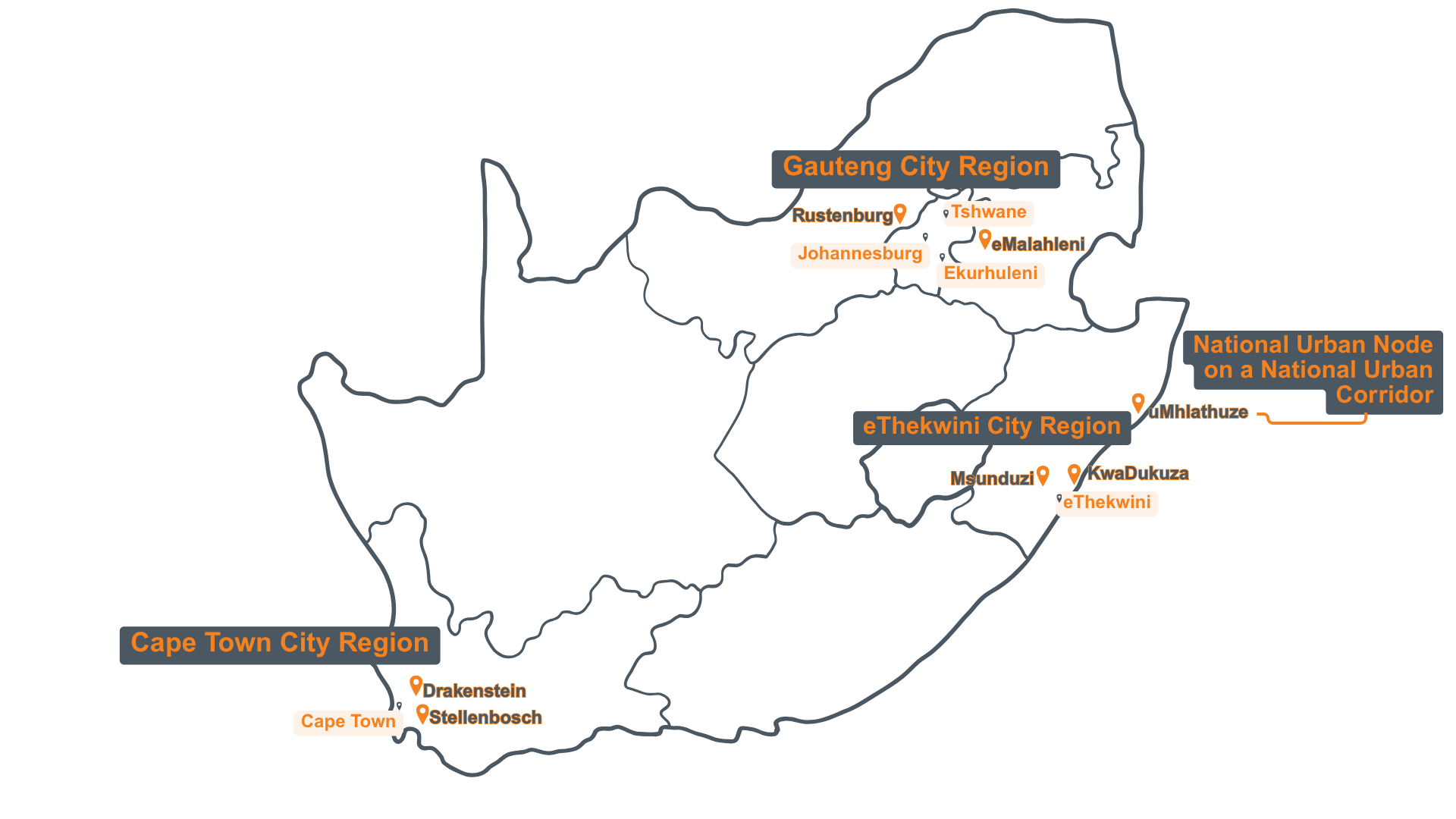
Twelve of the thirty-nine ICMs clearly form part of metropolitan city regions in South Africa, but SACN will focus on seven ICMs to start providing support in the first two years going forward, that is, 2026-27 and 2027-28:
- Stellenbosch
- Drakenstein
- Msunduzi
- KwaDukuza
- Rustenburg
- eMahaleni
- uMhlathuze
SACN’s value proposition is its niche as a credible, data-driven urban intelligence and learning hub, guiding how SACN designs evidence, learning platforms, and advocacy to support adoption. Our proposed offering to ICMs is a network that provides peer-to-peer learning and convening events, a knowledge hub, partnerships, advocacy for the urban agenda, and urban intelligence and foresight.
SACN’s role is to turn evidence into decision-ready insight, peer learning into measurable practice change and city experience into a stronger urban agenda. SACN creates value through urban intelligence and foresight, structured learning, evidence-led advocacy and strategic partnerships that support uptake and system change. SACN is not a delivery agency and does not replace the statutory or operational roles of government institutions. Its role is to strengthen system performance through data-driven evidence, learning, and convening, while staying focused on its unique role in the urban ecosystem.
SACN will offer the Urban Festival to all ICMs, with a primary focus on providing peer-learning events and customised support to the 7 ICMs working with the relevant SALGA Provincial Development Offices (PDOs). The advocacy work will focus on promoting a nuanced, differentiated approach rather than trying to do everything for all ICMs.
As South Africa’s urban landscape continues to evolve, so too must the way we plan, govern and invest in it. By adopting a city-region lens and extending support to strategically important Intermediate City Municipalities, the South African Cities Network is responding to the realities of how people, economies and infrastructure operate across municipal boundaries. Through evidence-based insights, peer learning, strategic partnerships and targeted advocacy, SACN aims to strengthen collaboration and build more resilient, inclusive and competitive urban systems. This approach is not simply about expanding the network, but about enabling cities and regions to work together more effectively to address shared challenges and unlock opportunities for sustainable urban development.